
You can write in Portuguese, English, Spanish or French. The search doesn't link to accents or uppercase letters, separates the words (all must appear) and also searches for the equivalent word in other languages: "transplant" finds "transplant" and "trasplante". Searches in the original titles, translated titles into Portuguese, descriptions and abstracts. MielomaAI.
In the last 3 months. From the older news, only the title and link remain in the archive. Those that have about 1 year may no longer be up to date
Looking for words: transplante. Saltar para: Recent news (9) · My Hematology (6) · explanations (6) · file (17)
 Sanofi and the pan-Canadian Pharmaceutical Alliance sign Letter of Intent for Sarclisa®(isatuximab), a step toward public access for newly diagnosed, transplant-ineligible multiple myeloma patientsPR Newswire Canada (Canadá) · 14:15 Doentes e associaçõesCanadá
- Sanofi and the Alliance Pharmaceutical PanCanadian sign a letter of intent for Sarclisa® (isatuximab), a further step towards public access for newly diagnosed patients with multiple myeloma who are not eligible for a transplant.PR Newswire Canada (Canada) · 14:15 TreatmentsCan you provide the French text you want me to translate?FR
/CNW/ -- Sanofi announced today the happy conclusion of negotiations with the Canadian Alliance Pharmaceutical (CPP), marked by the signing of a...
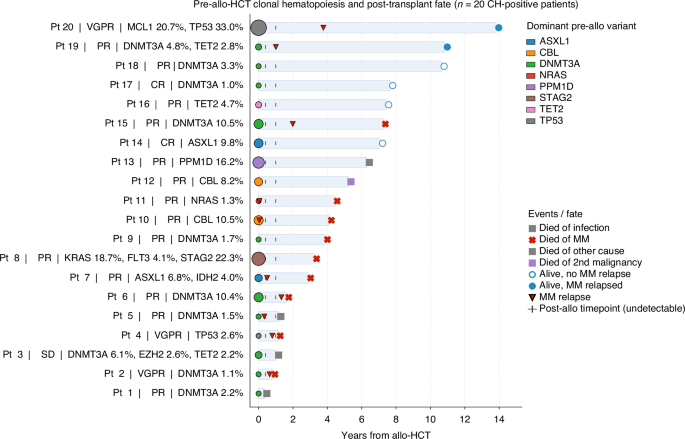 Allogeneic transplantation for plasma cell myeloma clears pre-transplant clonal haematopoiesis and is associated with a low rate of myeloid neoplasm post-cytotoxic-therapyNature (Reino Unido) · 07:00 TratamentosReino Unido
 Overview | Daratumumab with bortezomib, lenalidomide and dexamethasone for untreated multiple myeloma when a stem cell transplant is suitable | GuidanceNICE website (Reino Unido) · 07:00 TratamentosReino Unido
 Multiple Myeloma: At the IMSS with targeted therapies and autologous transplant, treatment options are expanded.IMSS (Mexico) · 07:00 TreatmentsMéxicoES
 MRD Ready to Guide Multiple Myeloma Treatment Decisions?MedPage Today · 17:32 Tratamentos
'MRD is becoming a very valuable tool, but it's not an exclusive tool,' says expert
 Lymphoma, Myeloma & Prostate CancerCure Today (EUA) · 15:00 Acesso e saúde públicaEUA
FDA approves Mozobil for non-Hodgkin lymphoma and myeloma, and Degarelix for advanced prostate cancer.
 New paradigm in the treatment of multiple myeloma: combinations secure funding in Portugal in line with European recommendations.My Hematologia (Portugal) · 16:26 Access and public healthPortugalPT
In October 2026, the National Health Service (SNS) began to fund (1) new combined therapeutic options for the treatment of multiple myeloma (MM) in adult patients, indicated for the first and second lines of intervention. This approval represents a milestone in access to innovation in Haematology oncology…
 New score improves survival prediction in elderly patients with multiple myeloma.My Hematologia — pesquisa "mieloma" (página 2) (Portugal) · 14:31 Patients and associationsPortugalPT
An international study has developed a new prognostic model for elderly patients with multiple myeloma who are not eligible for transplant, offering a more accurate alternative to traditional systems focused solely on the disease. Researchers created the Myeloma Elderly Prognostic Score (MEPS), a tool…
Click on an article to open it on the side with the summary. MielomaAI And the link to the source.
 Published American recommendations for the management of renal transplantation in patients with plasmacytic disorders.InternationalMy Hematologia · 5 Sep 2025
This article discusses how kidney transplantation can be an option for people with multiple myeloma and other diseases that damage the kidneys, but it still presents challenges. Read more →
 High doses of melphalan and stem cell transplantation increase survival and safety in patients with AL amyloidosis.InternationalMy Hematologia · August 18, 2022
This study, conducted by researchers at Boston University, shows that the use of high doses of melphalan, combined with stem cell transplantation, may increase the lifespan and safety of people with AL amyloidosis. Read more →
- High-risk multiple myeloma: is there an optimal therapeutic approach?NewsMy Hematologia · May 22, 2023
This article addresses the issue of the best therapeutic approach for high-risk multiple myeloma, based on the clinical case of a 61-year-old patient. The patient presented high-risk characteristics, such as a high concentration of free light chains, genetic alterations in the bone marrow, and an initial response to treatment with bortezomib, lenalidomide, and dexamethasone. Read more →
 The inclusion of daratumumab in first-line treatment allows a greater number of patients to access this drug in combination with protocols such as Rd or VMP and VTd.InterviewsMy Hematologia · May 12, 2022
This article discusses how daratumumab, a new drug, is being used in the treatment of multiple myeloma, a serious illness. The results of several studies have shown that this medication, when used with other treatments, can help improve patients’ health. Read more →
 This approval significantly changes the landscape and first-line treatment options for multiple myeloma.InterviewsMy Hematologia · May 12, 2022
The daratumumab, a medication that targets specific myeloma cells, has been approved for use at the very beginning of treatment. Expert Professor Paulo Lúcio believes that this may improve how multiple myeloma is treated, particularly in the early stages of the disease. Read more →
 Professor Doctor Catarina Geraldes highlights positive results from the addition of daratumumab to VMP and Rd schemes in the treatment of MM.InterviewsMy Hematologia · November 12, 2021
This article reports on a presentation by Dr. Catarina Geraldes at the meeting of the Portuguese Society of Hematology, where data on the use of the antibody daratumumab in the treatment of multiple myeloma were shared. Read more →
- Autologous transplant
- Stem cells are collected from the patient's own body, followed by intensive chemotherapy (melfalan) and then the cells are returned to the bone marrow to recover.
- Maintenance
- Milder and longer treatment after induction and transplant, to keep the myeloma under control for a longer period. Often it is lenalidomide in tablet form.
- Multiple myeloma active
- Plasma cells from myeloma in the bone marrow with CRAB (calcium, kidneys, anemia, bones) damage or with signs that they will soon cause, representing 60% or more of plasma cells, a light chain ratio of 100 or more, or more than one bone lesion seen on imaging. Management: Induction treatment (often 4 medications), autologous transplant where possible, and maintenance. Risk: Depends on the stage (R-ISS) and genetics. See the film "Types of myeloma" →
- IgD
- Rare: about 1 to 2% of patients. Almost always smoldering and in younger people. How it is managed: Usual treatment; bone marrow transplant is often proposed. Risk: Increased kidney damage and disease outside the bone marrow; it can be associated with plasma cell leukemia. See the film "Types of myeloma" →
- Multiple myeloma
- 5% or more of plasma cells circulating in the blood. Primary (at the very beginning) or secondary (in a relapse). How to manage it: Intensive and rapid treatment; transplant for those who can; clinical trials. Risk: Very high risk: the most aggressive form. See the film "Types of myeloma" →
- POEMS
- Rare syndrome with polyneuropathy, enlarged organs, hormonal changes, M protein (almost always lambda), and skin changes. How it is managed: Radiotherapy if the disease is localized; otherwise, treatment as in myeloma and transplant. Risk: Variable; nerves recover slowly. See the film "Types of myeloma" →
Access and public health
- FDA approves quadruplet with daratumumab in multiple myeloma without indication for transplant ↗ · Oncology News Central · 28/01/2026
- Four-drug regimen based on DARZALEX and FASPRO® approved in the US for newly diagnosed patients with multiple myeloma who are not eligible for transplant. ↗ · PR Newswire · 27/01/2026
Patients and associations
- Why should transplantation be considered earlier in patients with multiple myeloma? about 1 year · Roswell Park Comprehensive Cancer Center · June 24, 2025
- Isatuximab, lenalidomide, bortezomib and dexamethasone in the induction of newly diagnosed patients with eligibility for transplant: final analysis of progression-free survival part 1 of the GMMG-HD7 phase 3 trial. about 1 year · International Myeloma Society · January 30, 2025
- Stem cell transplant in multiple myeloma: Paul’s story ↗ 2 years · Roswell Park Comprehensive Cancer Center · 05/08/2024
Research
- Phase 3 study of teclistamab with lenalidomide, and teclistamab alone, versus lenalidomide in maintenance after autotransplant in newly diagnosed multiple myeloma: preliminary safety results from the MajesTEC-4/EMN30 trial ↗ about 1 year · International Myeloma Society · January 30, 2025
- Phase 2 study of inductions with teclistamab in patients newly diagnosed with transplant eligibility: results of the GMMG-HD10/DSMM-XX (MajesTEC-5) trial ↗ about 1 year · International Myeloma Society · January 30, 2025
- Efficacy and safety of Isa-KRd induction prior to adapted consolidation based on response in newly diagnosed multiple myeloma with indication for transplant: interim analysis of the IFM2020-02 MIDAS study ↗ 2 years · International Myeloma Society · 27/09/2024
Treatments
- Treatment induction based on teclistamab in patients with multiple myeloma who are eligible for transplant and with recent diagnosis: a phase 2 trial. ↗ · Nature · 25/06/2026
- Isatuximab in combination for multiple myeloma who are not yet treated when a transplant is not possible ↗ about 1 year · NICE website · 24/09/2025
- Summary | Daratumumab with lenalidomide and dexamethasone in the treatment of multiple myeloma who are not treated when transplantation is not possible | Recommendation ↗ 3 years · NICE website · 25/10/2023
- Motexafortide and stem cell transplants in the treatment of multiple myeloma ↗ 3 years · National Cancer Institute (.gov) · 07/07/2023
- Daratumumab in combination for multiple myeloma who is not treated when transplant is feasible ↗ 4 years ago · NICE website · 02/02/2022
- Few relapses 7 years after transplant in multiple myeloma ↗ 6 years · CancerNetwork · 17/06/2020
- Treatment of Acute Kidney Injury Caused by Multiple Myeloma with High-Flow Polisher Filter | Dialysis and Transplant ↗ 7 years · www.elsevier.com · 08/04/2019
- Recovery after a stem cell transplant in myeloma ↗ 8 years · Cancer Research UK · 30/06/2018
- Stem cell transplant in myeloma ↗ 8 years · Cancer Research UK · 29/06/2018